FLOORBEE Rubber
Elastic Rubber for Safe Connection of Rink Barrier Sections
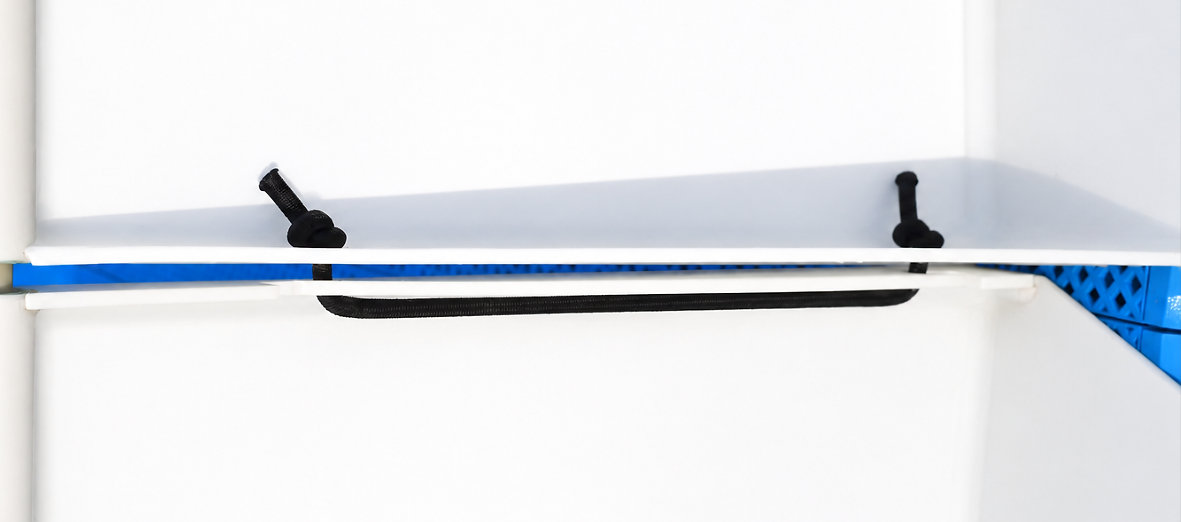
The elastic connecting rubber is used to join individual rink barrier sections. Unlike rigid connections, it allows the connection to release in a controlled manner and the barrier sections to partially separate in the event of an impact. This helps reduce the severity of the collision and improves player safety.
Why is a flexible connection important?
The barrier should be sufficiently stable during normal play, while also being able to respond to a strong impact. This is where the advantage of an elastic connection lies.
With rigid connections, such as metal elements, plastic pins or plastic clips, the individual barrier sections remain firmly connected during an impact. The barrier cannot separate, so the impact energy is transferred back to the player.
How does the elastic rubber work?
During normal use, it keeps the individual barrier sections securely connected. In the event of a stronger impact, however, the rubber allows the connection to release and the individual sections to partially separate. The movement of the barrier therefore helps absorb part of the impact energy.
Not necessarily. Simply removing metal from the connection does not mean that the barrier can separate during an impact. If the sections are rigidly connected using plastic pins or clips, the principle remains the same – the connection does not release and the impact is harder.
Why choose an elastic connection?
An elastic connection is a safer and more functional way of joining barrier sections. It combines stability during normal play with a flexible response to impact, contributing to a safer environment for everyone taking part in the game.
The price is stated per 1 metre.

Manufacturer/distributor
Necy s.r.o.
Pivovarská 573
68601 Uherské Hradiště, Czech republic
http://www.floorbee.com
gpsr@necy.eu
 DHL Express
 FedEx International Economy


